
Miss Lily Elsie (1886 - 1962)
Intruduction.
Miss Lily Elsie made her name on the opening night of The Merry Widow, in London, on 8th June 1907. Overnight she had the town at her feet. On the stage Elsie seemed mysteriously beautiful with her perfect Grecian profile, enormous blue eyes, and hauntingly sad smile. Tall, cool, and lily-like, she moved with lyrical gestures in a slow-motion grace.
She was a true 'star' of Edwardian times, although the word was yet to be used in that context. Magazines produced special supplements about her, adverts featured her picture.
Although her fame and fortune came entirely from public appearances she was painfully shy. After just a few years on the stage she retired to a quite life away from the public eye. She did however leave us with hundreds of pictures, a few gramophone discs, and two films, to remember her by.
Biography.
Born Elsie Hodder on 8th April 1886 in the Armley district of Leeds, in the northern English county of Yorkshire, she was to become one of the biggest stars of the Edwardian musical theatre stage. Her birth certificate records her mother, [Charlotte] Elizabeth Hodder's, occupation as 'Dress Maker'. No father is recorded.
Her mother was married on 19th March 1891 to William Thomas Cotton, at Chorlton on Medlock Register Office in Manchester. Young Elsie also took the name Cotton at this time. The family lived first in Manchester, then in the neighbouring city of Salford. (Best known for being the home town of painter L S Lowry.) William Cotton gave his occupation as 'Theatrical Baggage Master'. By the time of the 1901 census, Elsie senior was recording her occupation as 'Actress'.
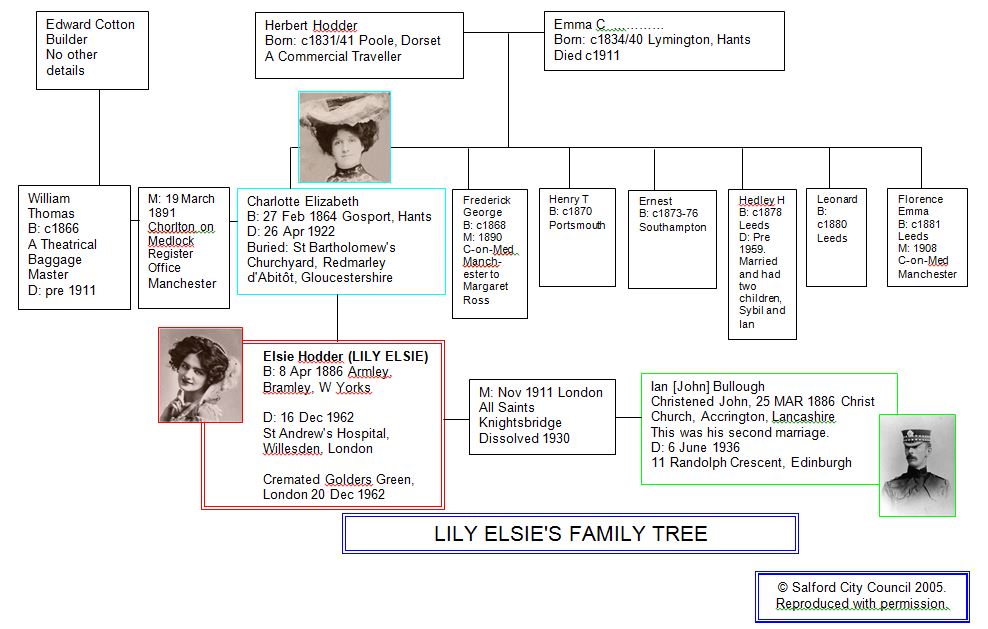
Elsie's family tree
For further details of Elsie's ancestry, please follow this link.
[Some sources record Elsie's mother as Elizabeth Barrett. This does not appear to fit with the documented facts we have from birth and marriage certificates.]
A precocious child star, young Elsie Cotton appeared in music hall entertainments as a child impersonator known as 'Little Elsie'.

Elsie with Sam Higham in about 1895 (age 9)
This is a scene from a sketch called 'There'll Come A Time', presented at the North Western Concert Hall and the Regent Theatre, both in Cross Lane, Salford. The photo appeared in the Salford City Reporter at the time of Elsie's marriage in 1911.
Middlesex music hall
An acceptable turn is given to the entertainment by Little Elsie, whose sweet voice is heard in "Queen of the Earth." It is a tremendous effort for so youthful a singer, but Miss Elsie, as also in the charming ballad, "Dear Heart," takes the highest notes with ease, and renders the exacting songs with good articulation and perfectly in tune, the house listening with rapt attention to the pretty child's efforts.
(The Era, London, Saturday, 30 September 1899, p.18a)
Around 1895/6 she appeared in concerts at the London and North Western Hotel on Cross Lane, Salford. Other appearances included the Prince of Wales Theatre, Liverpool Street and The Regent Theatre (later The Palace), Cross Lane, both in Salford. 1896/7 saw her in the role of Princess Mirza in The Arabian Nights at the Queen's Theatre (later The Palace) Bridge Street, Manchester. Then for Christmas 1896, at the age of ten, in the title role of 'Little Red Riding Hood' for six weeks followed by six weeks touring.
She toured the provinces, travelling to theatres as far afield as Bristol (South west England) and Hull (North east), before coming to Daly's Theatre in London as a chorus girl. From about 1900 she adopted the stage name 'Lily Elsie'.

Details from Elsie's birth certificate.
George Edwardes, the manager at Daly's, dropped in unexpectedly at a matinee, saw Elsie throw a balloon at the audience, so gave her notice to quit for insubordination. Some time later, meeting her in the street and hearing that she was still out of work, he took her back to play small parts. When she appeared in a Chinese musical (See-See), having been impressed by an oriental H Beerbohm Tree (1853-1917) production, she wore an oriental wig and make-up giving the illusion of slanting eyes. Her appearance caused a stir, for in musical comedy nobody bothered about realism. So while still in her teens she was already making her mark in major London productions.
When Edwardes found his Daly's theatre unexpectedly empty, and needed a leading lady quickly for his stop gap, The Merry Widow, he took Elsie to Berlin to see the German version (Die Lustige Witwe. Berliner Theatre, from 1st May 1906.). They arrived just in time to have high tea before going to the theatre. The leading actress (Mizzi Guenther) sang the part with tremendous operatic gusto. Edwardes asked Lily Elsie if she would play Sonia in London.

Mizzi Günther.
'Oh no, I couldn't possibly.' Lily Elsie was always shy and unsure of herself. She considered herself too thin, too ineffectual, and her small voice was never properly trained. Edwardes and Elsie returned, somewhat crestfallen, to London. But the Guv'nor (Edwardes), search as he did, could find no one else for the role, and the production had to go into immediate rehearsal. He eventually cajoled Elsie into becoming his Sonia, and by accepting, she made history in the English theatre.
...'She has never done anything to speak of,' he said, 'but I know she is clever and I believe she has a great future in front of her. I have the idea that she can play the part of Sonia and astonish them all....
Edwardes took Elsie to Lucile for what might today be called a 'style makeover'. One of the first things they did was to make her alter the style of her hairdressing and after one or two experiments to see what suited her, evolved the fashion of coiling it neatly and flat to that beautifully shaped little head of hers. The result was a complete change in her appearance and Edwardes was as delighted with it as much as she was.
Cecily Howard (Mrs Webster), the last surviving member of the original company, remembered Elsie on the first night waiting for her final entrance in the third act. The house had cheered itself hoarse and were in a state of ecstatic hysteria. Lily Elsie, with the typical modesty that was to remain with her all her life, turned and whispered: 'I think they like us!'
She could not understand that overnight she had become a living legend. The public exposure gained through her leading roles, coupled with stunning looks and strong singing voice, made Lily Elsie the Edwardian equivalent of today's top national celebrities. Her face adorned chocolate boxes, biscuit tins, and advertisements for cosmetics. Designers of fashionable clothes sold more by being associated with her, and every society lady wanted her own version of a 'Merry Widow Hat'.
For an illustrated magazine article from the USA, December 1911 Click here.
Among the famous designers whose clothes she wore was 'Lucile' (Lucy, Lady Duff Gordon. 1863-1935), particularly the costumes for The Merry Widow in 1907. Lucile later wrote; "That season was a very brilliant one, perhaps the most brilliant of the series which brought the social life of pre-war London to its peak. And just when it was at its zenith a new play was launched with a new actress, who set the whole Town raving over her beauty and a waltz that set the whole world dancing to its fascinating lilt..." Elsie's dresses for The Truth Game (1928) were specially designed and made by royal dressmaker Norman Hartnell.
Her fame brought invitations from the greatest in the land but she never accepted them. One elderly gentleman (a Mr Tyser) - a distant admirer - sent her a duplicate of her stage jewellery - only in real diamonds. Lloyd George (David [Lloyd] George. 1836-1945. British prime Minister 1916-22), a friend of Edwardes, formed a habit of watching Lily Elsie from the wings. It was only on the stage that she became less painfully shy. Many distinguished people had sent her interesting letters. She had never been brought up to answer letters, and she was hopelessly casual in such matters. She kept nothing of her past, except a few picture postcards.
She always retained a certain mystery and even those fortunate to know her off-stage found her slightly elusive with this unattainable quality that was utterly romantic. 'I have never been fool enough to give my heart to one of them,' she said, 'and so they think it must be worth having'
She had no head for business and often contrasted herself with Gabrielle Ray in that regard: Elsie told how she and Gabrielle Ray had contracts to be photographed exclusively for picture postcard sales by Foulsham and Banfield (Rotary Photo EC) once every month, how artificial light was never used but they were taken in a 'sort of conservatory'. Gaby Ray was the bright one: she always insisted on marking the proofs herself for the alterations, and she arranged to be paid £400 a year for posing whereas Elsie had signed too soon and only received £100 a year.
'I'm always rude to men,' she once confided in Lucile, 'And the ruder I am the more they like me.'This was indeed true. Another example from Lucile's memoirs;
"...On the first night of 'The Dollar Princess' I joined them both. Lily Elsie was looking radiant and I noticed that she was wearing a necklace which had been sent to her by one of the richest men in London. It had arrived as a porte bonheur for her first night and we examined it together..."
"...It was composed of rubies which lay like a blood-red streak round her neck. One very large and flawless diamond was suspended from it. Its value must have run into many thousands of pounds for the stones had been specially selected..."
"...While we were looking at it, Lily Elsie's mother came in with the message that the sender was waiting outside the dressing room to know when he might take Lily out to lunch or dinner..."
"....'Oh, and I have not one free day for a fortnight,' she said carelessly. 'I'm afraid he will have to wait' ..."
"...'You can't be so unkind after getting that lovely present,' her mother said. 'Do fix up something to cheer him up a bit. I am getting tired of telling him you can't see him'..."
"...'Oh have it your own way then. Tell him he can come and take me out on Wednesday' ...."
"...We heard his profuse thanks at the door..."
For a long time her name was whispered in romantic connection with Willie Isaacs, a man-about-town said to have worldly charm, a gay humour, bravura, and vitality. When he died he left Elsie a considerable fortune.
It was however, six foot three inch Ian Bullough, the twenty-six year old son of a millionaire textile manufacturer of Accrington, whom Elsie eventually married. Ian was the step brother of Sir George Bullough. He had previously married the musical comedy actress Maudi Darrell (Maude Rhoda Didcott), who died at an early age.
Lily Elsie and Major Ian Bullough were married on 7th November 1911 at All Saints Church, 67 Ennismore Gardens, Knightsbridge, London, SW7 1NH. Marriage notice. Her empire-style wedding dress, was made by Lucile, of palest pink embroidered with pearls and trimmed with ermine. (She later said she thought it was hideous.)
|
|
|
|
|


The ceremony was performed by Rev. James R. Hale, Vicar of Boxley. The bride was given away by the Hon. Charles Russell, unsuccessful Liberal candidate for Salford in the 1910 election(s). [Prime minister Herbert Henry Asquith, Liberal.] Her mother Elsie was also there and Gertrude Glynn, her inseparable friend and understudy was her one bridesmaid. The third official witness to the service was Geoffrey Mayhew. The honeymoon was spent at the Ritz in Paris.

Miss Gertrude Glynn and Miss Gaynor Rowlands.
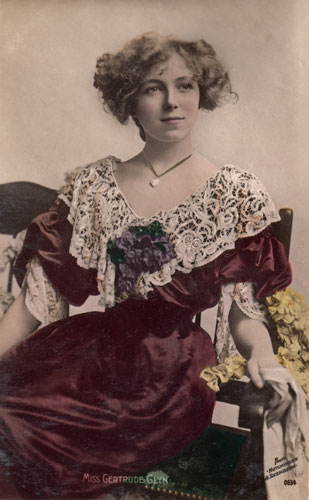
Miss Gertrude Glynn
In 1920 Major & Mrs Bullough moved to the Gloucestershire village of Redmarley d'Abitôt. Click here for more details.
Many aspects of her fame had frightened and exhausted her. The opportunity to spend time away from the public eye suited her temperament. She led a happy life surrounded by dogs, riding to hounds, fishing, and playing golf. Click here for some extracts from her 'hunting notebook'.
Elsie was never strong, she had been a delicate sickly child starting life in conditions of some poverty. During her years on the stage she had to undergo several operations. She found eight performances a week in the heavy singing role of the Widow, with much dancing as well, too physically taxing for her. She was said to have become 'difficult'. She would make excuses for not appearing at matinées; she hoped to take next week off; her complaints of fatigue became tiresome. The theatrical gossip pages of The Pelican referred to her as 'the occasional actress'.
It is quite probable that throughout her life her health was frail and that she suffered from anaemia. It has been suggested that Elsie had the menopause at the early age of twenty-two and that the resultant frigidity may have contributed to her marriage being unsuccessful. Allegedly her husband went through several phases as a serious alcoholic.
They separated, returned to each other, but finally the marriage came to an end in 1930.
It was said to have been an early fascination with Lily Elsie that started Cecil Beaton's (Sir Cecil Walter Hardy Beaton 1904-1980) interest in fashion & costume. He became obsessed with images of fashionable, beautiful women and photographic portraiture. In later years he avidly collected photographs of Elsie.
 Photo of Elsie at Windsor in 1941 by Cecil Beaton.
In later life her health deteriorated further. She became a hypochondriac and spent much time in nursing homes and Swiss sanatoria. She was looked after by her niece [cousin?], Elsie Wilkinson, and her friend Binkie Moss. Eventually she became so quarrelsome that even these devoted supporters left her. Fortunately, her finances were such that she could pay to be looked after to a high standard for the rest of her days. Her psychological condition deteriorated to such an extent that she underwent brain surgery. As a result her health generally improved.
It is reported that Hummingbird House, Lewes, West Sussex, UK was so named as Elsie lived there although between which dates is uncertain. A reference to her role in the comic opera See See during 1906. We are currently seeking further information (April 2016). Photo
Her last years were spent at St Andrew's Hospital, Dollis Hill, Willesden, London NW2, (Room 34). St Andrews was built in 1913. It was run by Sisters of the Little Company of Mary aka the Blue Nuns. St Andrew's was a private hospital but had some wards for geriatric NHS patients. It even had a small casualty/A&E. Someone who worked there at the time describes Elsie as a ‘valetudinarian’ -not ill, but looked after more than in a hotel. Elsie was extremely happy in her anonymity and would occasionally be taken by friends for a ride in a motor car and to have tea at Henley or Hampton Court.
Miss Lily Elsie died at St Andrew's Hospital on 16th December 1962, aged 76. Her death certificate records the cause as 'Heart failure/bronchopneumonia'. She was cremated at Golders Green on December 20th. The hospital closed in 1973 and the site has since been re-developed. We have a copy of her will.
 Elsie's obituary from the London Times, 18th Dec 1962
There is a wonderful interview with Elsie, including a photograph of her Mother, on John Culme's most excellent web site, "Concerning Lily Elsie". (Moved? July 2020)
How to Succeed in Musical Comedy an article by Lily Elsie from Every-Woman's Encyclopaedia.
Elsie's obituary from The Stage and Television Today, 20th Dec 1962, page 17.
